
Most people assume solar panels mean months of back-and-forth with the council. They imagine planning applications, neighbour objections, and delays that push the whole project into next year.
The good news is that most Irish homeowners do not need planning permission for solar panels. The rules changed in 2022, and the exemptions are fairly generous. But there are limits, and some situations still require you to go through the formal process.
This post covers exactly when you’re exempt, when you’re not, and what to do if your home falls into a grey area. You’ll also find out what questions to ask your installer before any work starts.
Do You Need Planning Permission for Solar Panels? The Short Answer
No, in most cases you don’t. Solar panels on a house roof are classified as exempt development under Irish planning law, provided your installation stays within certain limits.
The rules fall under the Planning and Development Regulations. The 2022 amendments expanded the exemptions significantly, making it much easier for homeowners to go solar without dealing with An Bord Pleanála or your local county council.
That said, the exemptions come with specific conditions. Get one of them wrong, and you could technically be outside the exemption, even with a small system.
What the Exemption Actually Covers

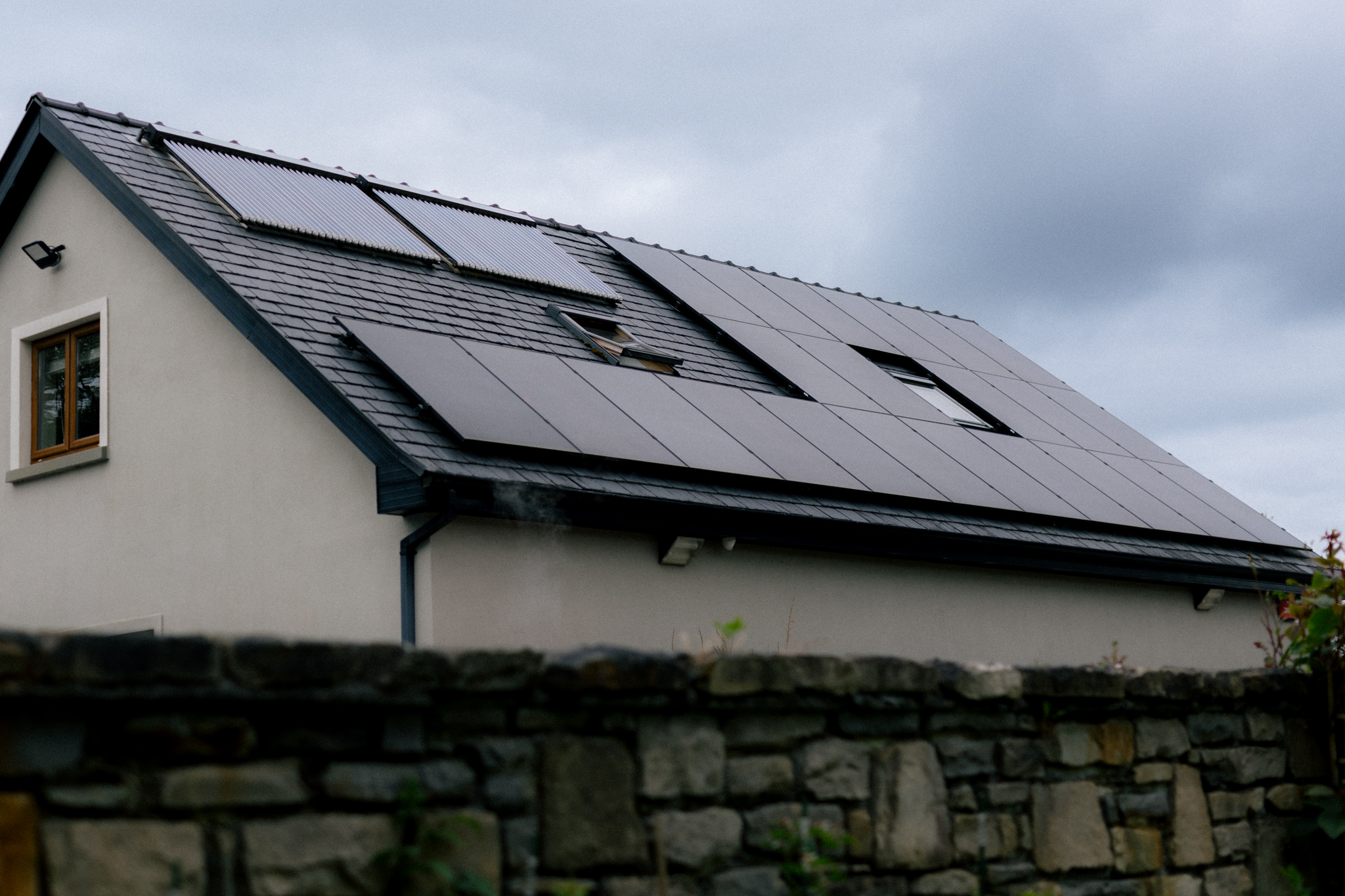
The exemption applies to solar panels mounted on the roof of a house. It covers both the main roof and any garage or outbuilding within the property.
Here are the key conditions that must be met for the exemption to apply:
- The panels must not project more than 15 cm from the roof surface or wall.
- The total area of panels on a pitched roof must not exceed 50% of the total roof area on that slope.
- The panels must not be higher than the highest point of the roof.
- On a flat roof, panels must sit at least 50 cm from the edge of the roof.
- The installation must not obstruct any chimney or vent.
If your system ticks all those boxes, you’re exempt. No application needed, no fee, no waiting period.
When You Might Still Need Planning Permission
There are specific situations where the exemption does not apply, and you’ll need to go through the formal planning process.
Protected Structures
If your home is a protected structure or sits within an Architectural Conservation Area (ACA), the exemptions don’t apply to you. You’ll need to apply to your local authority before any work starts.
This affects a meaningful number of homes across Ireland. Georgian terraces in Dublin’s south inner city, period homes in Kilkenny’s city centre, and many older stone farmhouses across Connacht and Munster fall into this category.
Check your property on your local council’s Record of Protected Structures before assuming you’re exempt. Most councils publish this online. Dublin City Council, Cork City Council, and Galway City Council all have searchable databases.
Apartments and Multi-Unit Buildings
The residential exemptions apply to houses, not apartments or multi-unit developments. If you own an apartment, you’ll need permission from your management company and potentially a planning application too.
This is worth raising early if you’re in a duplex or terraced arrangement where the roof is shared.
Ground-Mounted Systems
If you want to put panels in your garden rather than on your roof, different rules apply. Ground-mounted systems on a domestic property are allowed without planning permission under certain conditions, but the area is capped, and the panels can’t be visible from a public road.
Most residential ground-mount systems stay within the exemptions, but get your installer to confirm the specifics for your site.
The 2022 Rule Change: What It Means for You
Before 2022, the exemptions for solar were much tighter. The 12-square-metre cap that existed under the older rules meant many homeowners were being pushed into planning applications for perfectly ordinary rooftop systems.
The updated regulations removed that square metre cap for rooftop residential solar. That’s a significant change. A 5kW system using 13 panels covers roughly 22 square metres. Under the old rules, that required planning permission. Under the new rules, it’s exempt provided the other conditions are met.
The 2022 changes also introduced the exemption for solar on agricultural buildings, which opened up a huge opportunity for farmers to generate their own power. That’s a separate topic, but it shows how broadly the exemptions have been extended.
Exempted Development vs. Permitted Development: What’s the Difference?
This trips people up. Exempted development means you don’t need planning permission at all. Permitted development is a term used in the UK planning system, not in Ireland.
If anyone quotes “permitted development” at you in an Irish context, they’re using the wrong terminology. In Ireland, we work with exempted development. Same concept, different legal framework.
Your installer should know the difference. If they don’t, that’s a flag.
What If You’re Not Sure? Get a Section 5 Declaration

If there’s any doubt about whether your installation qualifies as exempt, you can apply for a Section 5 Declaration from your local planning authority.
This is a formal written confirmation that your project either is or isn’t exempt from development. It costs around €80, and your council must respond within 4 weeks.
It’s a sensible step if you’re in an older property, near a protected structure, or if your roof is unusually configured. An SEAI-registered installer can usually tell you upfront whether a Section 5 is worth getting in your situation.
How to Check Your Specific Situation
Here’s a simple process to work through before you commit to an installation.
Step 1 Check your property’s status. Look up your address on your local council’s Record of Protected Structures. Also check if your street or area is designated an Architectural Conservation Area.
Step 2 Look at your roof layout. Measure the total area of the slope where panels will go. Your panels can’t cover more than half of it.
Step 3 Talk to your installer. Any SEAI-registered installer will be familiar with the exemption conditions. Ask them to confirm in writing that your planned system qualifies as exempt development.
Step 4 If in doubt, apply for a Section 5 Declaration. It’s cheap, it’s fast, and it gives you written certainty.
Step 5 Keep a record. Even though you don’t need planning permission, keep documentation of your installer’s confirmation and any correspondence with the council. It’s useful if you ever sell the property.
Does Planning Permission Affect the SEAI Grant?
No. The SEAI Solar PV grant doesn’t require planning permission as a condition. You just need to use an SEAI-registered installer and follow the standard application process.
The current grant is worth €900 per kWp up to 4 kWp. That’s €3,600 off a standard 4kW system. You claim it after the installation is complete, and your installer typically handles the paperwork.
The only scenario where planning could hold up a grant application is if your local authority raises an enforcement issue. That’s vanishingly rare for a straightforward rooftop installation that’s clearly within the exemptions.
Selling Your Home After Installing Solar: What Buyers Ask
If you ever sell your home, a buyer’s solicitor will ask whether your solar panels required planning permission. You’ll want to be able to show that the installation was exempt development.
The cleanest way to do this is to have a letter from your SEAI-registered installer confirming the system complies with the exemption conditions. Keep the installation certificate, the MCS or equivalent documentation, and any grid connection paperwork from ESB Networks.
Solicitors see solar systems regularly now. A tidy paper trail makes the conveyancing process smooth. A poorly documented one can cause unnecessary delays when you’re trying to close a sale.
Planning Permission for Solar Panels: The Bottom Line
Most homeowners in Ireland don’t need planning permission for solar panels. The exemptions introduced in 2022 cover the vast majority of standard rooftop installations on houses.
You do need to stay within the conditions, and protected structures or ACAs are the main exception to watch for. If you’re unsure, a Section 5 Declaration from your local council will clear it up quickly and cheaply.
The best next step is to get quotes from two or three SEAI-registered installers and ask each one to confirm your property qualifies as exempt. From there, you can focus on the part that actually matters — getting your system up and your electricity bills down.